 The painting’s curious technical aspects remained largely unexplored until 1996, when a scientific investigation was launched to determine how the forgery was crafted. ‘Portrait Group’ was painted on a thin wood panel, which was stuck on to a thicker panel of old wood and artificially cracked to heighten the impression of great age.
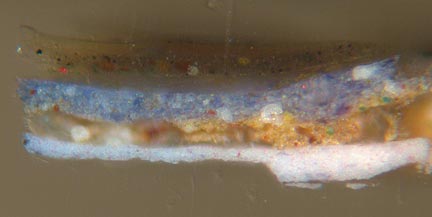
Cross-section of 'Portrait Group'. A layer of shellac was applied over a layer of paint containing the 19th-century pigment, cobalt blue. Just above is a thin, darker brown layer, possibly animal glue, deliberately tinted to ‘age’ the painting
Although the traditional gesso ground and egg tempera medium were used (the latter confirmed by GC-MS analysis and FTIR microscopy), SEM-EDX analysis identified a number of modern pigments in the samples of painting colors: cobalt blue, cadmium yellow, viridian and chrome yellow. None of these were available before the 19th century.
The paint layer is covered with a layer of shellac (a resin-like substance secreted by the lac insect) mixed with pine resin ? probably a cheap, commercially prepared varnish. Covering this is a layer of what appears to be animal glue, deliberately tinted to give the appearance of age, and a second layer of varnish. These upper layers produced the curiously ‘flinty’ character and brownish tonality of the deceptively aged surface. As the shellac dried it contracted, creating a craquelure in the paint below. Superficially at least, this simulated the surface craquelure typical for paintings realistic of the 15th century.
Modern forgers
Although scientific investigation has revealed the methods used to manufacture the painting, we still do not know who might have devised such a complex and sophisticated forgery. It has been proposed that the Gallery’s picture is the work of the Italian restorer and master forger Icilio Federico Joni (1866–1946). However, it bears little resemblance to his usual forgeries of 14th- and early 15th-century Sienese paintings. Recently it has been suggested that one of Joni’s contemporaries, Umberto Giunti (1886–1970), might have painted the work.

No comments:
Post a Comment