Wednesday, March 9, 2011

Historical background


The early twentieth century was characterized by startling changes in artistic painting techniques. In the visual arts, such innovations as cubism, Dada and surrealism, following hot on the heels of Symbolism, post-Impressionism and Fauvism, were not universally appreciated. The majority of people in Germany, as elsewhere, did not care for the new art which many resented as elitist, morally suspect and too often incomprehensible.
 
During recent years, Germany had become a major center of avant-garde art. It was the birthplace of Expressionism in painting and sculpture, the atonal musical compositions of Arnold Schoenberg, and the jazz-influenced work of Paul Hindemith and Kurt Weill. Robert Wiene’s The Cabinet of Dr. Caligari and Fritz Lang’s Metropolis brought expressionism to cinema.
The Nazis viewed the culture of the Weimar period with disgust. Their response stemmed partly from conservative aesthetics and partly from their determination to use culture aspropaganda. Upon becoming dictator in 1933, Hitler gave his personal artistic preference the force of law to a degree rarely known before. Only in Stalin’s Soviet Union, where Socialist Realism had become the mandatory art painting techniques, had a state shown such concern with regulation of the arts. In the case of Germany, the model was to be classical Greek and Roman art, seen by Hitler as an art whose exterior form embodied an inner racial ideal.
The reason for this, as historian Henry Grosshans indicates, is that Hitler “saw Greek and Roman art as uncontaminated by Jewish influences. Modern art was [seen as] an act of aesthetic violence by the Jews against the German spirit. Such was true to Hitler even though only Liebermann, Meidner, Freundlich, and Marc Chagall, among those who made significant contributions to the German modernist movement, were Jewish. But Hitler … took upon himself the responsibility of deciding who, in matters of culture, thought and acted like a Jew.”
The supposedly “Jewish” nature of art that was indecipherable, distorted, or that represented “depraved” subject matter was explained through the concept of degeneracy, which held that distorted and corrupted art was a symptom of an inferior race. By propagating the theory of degeneracy, the Nazis combined their anti-Semitism with their drive to control the culture, thus consolidating public support for both campaigns.
Their efforts in this regard were unquestionably aided by a popular hostility to Modernism that predated their movement.

Art of the Third Reich


The Art of the Third Reich, the officially approved art produced in Nazi Germany between 1933 and 1945, was characterized by a style of Romantic realism based on classical models. While banning modern painting techniques as degenerate, the Nazis promoted paintings and sculptures that were narrowly traditional in manner and that exalted the “blood and soil” values of racial purity, militarism, and obedience. Other popular themes for Nazi art were the Volk at work in the fields, a return to the simple virtues of Heimat (love of homeland), the manly virtues of the National Socialist struggle, and the lauding of the female activities of child bearing and raising (Kinder, Küche, Kirche).
Similarly, music was expected to be tonal and free of jazz influence; films and plays were censored.
Nazi art bears a close similarity to the Soviet propaganda art style of Socialist Realism, and the term heroic realism has sometimes been used to describe both artistic art painting techniques.
Among the well known artists endorsed by the Nazis were the sculptors Josef Thorak and Arno Breker, and painters Werner Peiner, Adolf Wissel and Conrad Hommel.

Different visions


It may seem surprising that the ‘Portrait Group’ could ever have been mistaken for an authentic Italian portrait of the late 15th century, even without the insight of modern scientific analysis. The hard linearity of the figures grossly exaggerates the delicate clarity of 15th-century profile paintings realistic, and the faces themselves seem just a little too modern.

However, early 20th-century viewers could easily have discounted features made familiar by the taste of their own age. Details that now appear inappropriately modern would have simply proved for those viewers the ‘ageless’ appeal of Renaissance painting techniques.

Marjorie E. Wieseman is Curator of Dutch paintings at National Gallery. This material was published on 30 June 2010 to coincide with the exhibition Close Examination: Fakes, Mistakes and Discoveries


Scientific analysis


The painting’s curious technical aspects remained largely unexplored until 1996, when a scientific investigation was launched to determine how the forgery was crafted. ‘Portrait Group’ was painted on a thin wood panel, which was stuck on to a thicker panel of old wood and artificially cracked to heighten the impression of great age.
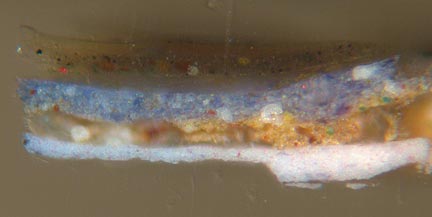
Cross-section of 'Portrait Group'. A layer of shellac was applied over a layer of paint containing the 19th-century pigment, cobalt blue. Just above is a thin, darker brown layer, possibly animal glue, deliberately tinted to ‘age’ the painting
Although the traditional gesso ground and egg tempera medium were used (the latter confirmed by GC-MS analysis and FTIR microscopy), SEM-EDX analysis identified a number of modern pigments in the samples of painting colors: cobalt blue, cadmium yellow, viridian and chrome yellow. None of these were available before the 19th century.
The paint layer is covered with a layer of shellac (a resin-like substance secreted by the lac insect) mixed with pine resin ? probably a cheap, commercially prepared varnish. Covering this is a layer of what appears to be animal glue, deliberately tinted to give the appearance of age, and a second layer of varnish. These upper layers produced the curiously ‘flinty’ character and brownish tonality of the deceptively aged surface. As the shellac dried it contracted, creating a craquelure in the paint below. Superficially at least, this simulated the surface craquelure typical for paintings realistic of the 15th century.

Modern forgers
Although scientific investigation has revealed the methods used to manufacture the painting, we still do not know who might have devised such a complex and sophisticated forgery. It has been proposed that the Gallery’s picture is the work of the Italian restorer and master forger Icilio Federico Joni (1866–1946). However, it bears little resemblance to his usual forgeries of 14th- and early 15th-century Sienese paintings. Recently it has been suggested that one of Joni’s contemporaries, Umberto Giunti (1886–1970), might have painted the work.

‘Renaissance’ portrait was unmask as FORGERY


Italian ‘Renaissance’ portrait was unmask as a remarkably sophisticated 20th-century forgery.

Sometimes we see what we want to see. When this Italian ‘Renaissance’ portrait was acquired by the National Gallery in 1923, it was hailed as a unique art painting techniques by an undiscovered master of the 15th century. Since the 1950s, connoisseurship, art historical research and scientific analysis have combined forces to unmask a remarkably sophisticated 20th-century forgery.
This portrait was acquired by the National Gallery in 1923 as a painting techniques of the late 15th century, possibly by an accomplished but unknown artist in the circle of Melozzo da Forli (1438?1494), an artist primarily active in Urbino and Rome. The armorial badge stamped into the gesso at upper right suggested the sitters were members of the Montefeltro family of Urbino, although no family members of the appropriate age and gender could be identified.